Hi, Quan! Could you introduce yourself to our readers?
Hi everyone! My name is Mai Hoang Quan, I'm 21 years old, and I'm from Vietnam. I'm currently in my third year of studying mechatronics and robotics at ITMO University.
What inspired you to choose that subject?
When I was in school in Vietnam, I really enjoyed physics and mathematics, so choosing a technical field felt natural to me.
Another reason is that robotics and artificial intelligence are becoming increasingly popular. I believe these technologies will play an important role in the future, and I wanted to study something connected to them.
What brought you to Russia – and ITMO in particular?
I received a scholarship to study in Russia. At the time, I also had a friend from Vietnam who was planning to come here. He recommended ITMO to me because it's a well-known, modern university with strong programs in IT, robotics, and other technical fields.
You mentioned receiving a scholarship. Could you tell us more about it?
I actually received two scholarships. The first one is from the Russian government, which covers my tuition and provides a monthly stipend, and the second scholarship is from the Vietnamese government.
I received the Vietnamese scholarship because I participated in a national physics competition when I was in high school and won a bronze medal. That achievement gave me the opportunity to study abroad.
For students interested in similar opportunities, I would recommend participating in academic competitions and Olympiads. They can open doors to scholarships and international education.
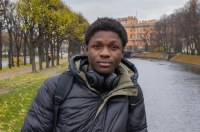
Mai Hoang Quan by Lomonosov Bridge in St. Petersburg. Photo courtesy of the subject.
You're studying in Russian. How challenging was it to learn the language before starting your degree?
Before beginning my Bachelor's degree, I spent a year studying Russian in the Foundation Program. That helped me prepare for my studies, so the transition wasn't too difficult overall.
However, I still sometimes struggle with specialized vocabulary, especially scientific and technical terms. Even when you understand everyday Russian, academic language can be quite different.
What was the biggest challenge when you started your Bachelor's program?
The most difficult part was understanding the teachers during lectures. In the first year, some professors spoke very quickly, and sometimes I didn't understand the assignments or even what I was supposed to do.
Fortunately, I had good classmates who helped me. That's why I always recommend that international students make friends with Russian students. They can help you with homework, laboratory assignments, and other things.
My advice is simple: don't be shy about asking questions!
Speaking of learning Russian, what advice would you give to students currently enrolled in the Foundation Program?
I think the most important thing is to take your language studies seriously from the beginning. Attend your classes, listen to your teachers, complete your assignments, and practice speaking Russian as much as possible. Try to communicate with your classmates and teachers, even if you're afraid of making mistakes.
Some students think the Foundation Program is the perfect time to relax and travel because the following years of university will be much more difficult. I've heard people say that you should enjoy your first year before the real studying begins. But I don't agree – learning Russian properly during that year is very important because you'll need it throughout your degree.
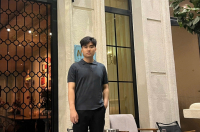
Mai Hoang Quan with his certificate at ITMO University. Photo courtesy of the subject.
Now that you're in your third year, what areas of robotics interest you the most?
In the third year, we have more opportunities to explore different directions within robotics. For example, we can focus on artificial intelligence, electrical systems, or robot navigation.
Personally, I'm most interested in artificial intelligence. I would like to learn more about computer vision and how AI can be used in robotics. I think this is the direction I want to pursue in the future.
And what are your plans after graduation?
First, I would like to continue my education and pursue a Master's degree. After that, I hope to work as an engineer, preferably in a field connected to artificial intelligence and robotics.
What about St. Petersburg? Have you discovered any favorite places in the city?
Yes! I really like [the town of] Pushkin and Nevsky Prospekt. When I have classes on Lomonosova Street, I often walk along Nevsky on my way home. I enjoy seeing all the people there, especially the street performers and musicians. Sometimes, there are people singing or doing something interesting, and I like stopping to watch. There's always something happening.
I also enjoy going into the city during public holidays to watch the fireworks. It's a really nice experience.

Mai Hoang Quan exploring St. Petersburg. Photo courtesy of the subject.

Mai Hoang Quan visiting the Museum of the History of Money in St. Petersburg. Photo courtesy of the subject.
How do you usually spend your free time? Do you have any hobbies?
I love playing football! During my first and second years, I played quite often, but now that I'm in my third year, I don't have as much free time. I also enjoy playing video games and watching sports competitions, especially football tournaments.
Finally, what advice would you give to international students who are considering applying to ITMO?
My advice is to pay close attention to the application process. Follow the university's official pages and check the information about admissions regularly. Make sure you know the application deadlines and prepare all your documents in advance. It's important not to miss any key dates.
And once you arrive, take your studies seriously, especially if you need to learn Russian.
Don't be afraid to communicate with other students or ask for help. Making friends and supporting each other can make your university experience much easier.