Hi Bilal! Let’s begin with your story. What inspired you to pursue a Master's in automation and control?
My primary motivation for automation and control goes back to my Bachelor’s. I studied mechatronics and robotics during my Bachelor's, and that built my keen interest in this field. No matter what work we do, in the end, the goal is to always control the output as we desire. What we see in the output is the mere result of some algorithm working behind the scenes. Still, it is much more complex to actually produce that algorithm based on the given scenarios and conditions, which takes considerably more effort and brainstorming than we think. Hence, this combination of automation and robotics inspired me to pursue this program in particular.
I chose ITMO because there is no doubt that it is one of the fastest-growing universities, not just in Russia but also in the world. Moreover, at ITMO, we have the freedom to study at our own pace rather than following a strictly structured schedule.
What was your first impression of life in St. Petersburg and the academic atmosphere at ITMO?
Before coming here, I had already watched an enormous amount of videos and vlogs related to St. Petersburg, and the only thing remaining was to experience them in person. I don’t think I have watched as many videos related to a place as I have done for St. Petersburg. The life and academic atmosphere at ITMO amazes me to this day, as this kind of freedom for academics is very rarely found anywhere, and it certainly feels like you are studying at home.
Are there any industries or real-world problems you’re particularly passionate about engaging with?
What excites me most about automation and control systems is the ability to improve efficiency and precision in complex systems. Surely it can never go to 100% but there is always some room for improvement. The idea of designing systems that can self-regulate, optimize performance, adapt to external and internal changes, and minimize human error is truly fascinating.
Tell us about a course, lab, or project at ITMO that has challenged or inspired you the most so far.
The project that stood out for me was programming a PID controller for a physical plant with encrypted state output. The hardest part was to decode the incoming data from the plant and to clean it to remove false bytes to ensure a consistent state output, and then to program the PID controller by filtering the incoming data. That project allowed me to improve my programming skills with real plants as well as my skills in data handling.
In your experience, how does the learning environment at ITMO compare to that in Pakistan?
Back in Pakistan, the learning environment involves old methods, strict schedules, and theoretical learning without much hands-on-training, whereas at ITMO, I find it very interesting that each professional course we study has some sort of practical learning and training to enhance the practical skills.
What are some emerging technologies or tools in automation that you’re excited to work with?
Autonomous robots are one of the best emerging technologies that will work alongside humans and will be able to navigate their own paths and make their own decisions without depending on human interaction, and that will be the peak of automation. My field is not purely robotics, but I have recent experience in it, and I would love to apply my specialties in automation in the field of intelligent robots.
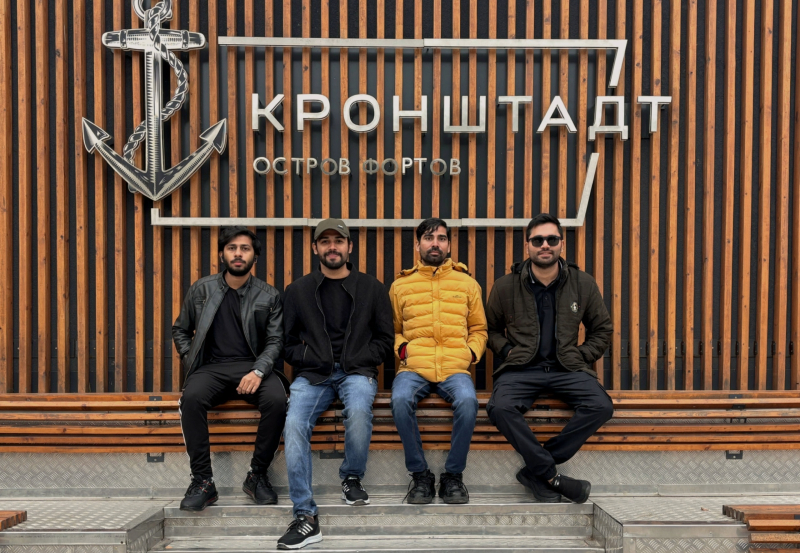
Muhammad-Bilal Muhiuddin with his friends in Kronstadt. Photo courtesy of the subject
Have you faced any cultural or language adjustments while living in Russia?
To be honest, yes, I have faced language difficulties and am still facing them currently, but that is how you learn and adapt to different environments and social norms. I have learned that it is better not to rush to adapt to a different environment, as it will come naturally to you, and slowly you will adapt and see yourself becoming better each day.
What’s your favorite place to visit when you want to relax or get inspired?
The city center on Nevsky Prospekt is my favorite place to go to with friends whenever I am bored or want to find something to do. Just walking there along the river and buildings makes you feel relaxed as the architectural masterpieces make you think that you are living the history of this city, and you can find a number of restaurants to try different national and international cuisines.
As a student of automation, how do you view the future of human-machine collaboration?
There is always this debate about “will machines take over,” and everyone has their justified opinions as well. My thought is that yes, the machines will take over, but only to some extent, and will not fully replace the humans, as they will still be dependent on them. I see the future of human-machine collaboration as a distinct subject because it will be needed to understand the use of AI and to collaborate with machines to some extent in the upcoming era. Otherwise, you can be left behind. We can already see the inclusion of machines and AI even in the very basic tasks that we do in our daily lives.
What’s one misconception people often have about automation or control systems that you’d like to clear up?
People often think that automation is a universal problem with a universal solution, but that is not the case; each automation problem is unique and different from others, and you need to take the time to determine the requirements to solve it. Yes, there are some globally accepted algorithms and solutions, but they are limited to a number of problems. It is like you spend more time understanding the problem than solving it. Another big misconception is that it will completely replace human workers. Yes, it will reduce human work and employment to a certain rate, but it can never replace them completely since there will always be a need to manage and troubleshoot the systems.
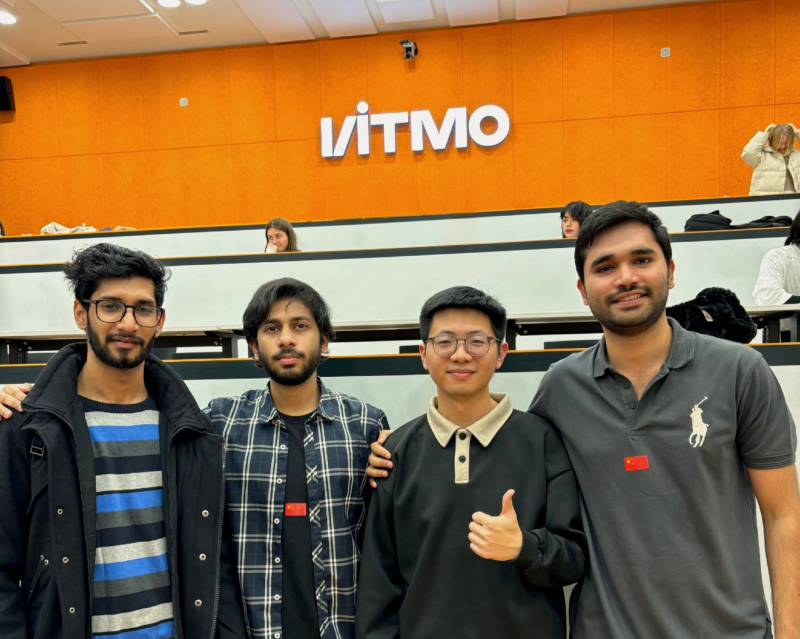
Muhammad-Bilal Muhiuddin with his friends at ITMO. Photo courtesy of the subject
How has this international experience shaped your mindset?
It feels like I have burst out of a shell throughout this international experience. It has allowed me to come out of my comfort zone and taught me the daily life skills I need to survive. I have learnt to navigate different social norms and can now collaborate with people from diverse backgrounds. It has also given me a sense of independence and the confidence to tackle challenges in both academic and personal life.
What advice would you give to future students considering studying at ITMO?
I have only two genuine pieces of advice for future students who want to pursue this Master’s program at ITMO:
- You must be keen to learn automation and not just choose this program because it’s available.
- You must have some background knowledge related to automation, control systems, and programming because the course will not cover this background, and it will further burden you.
Finally, what’s one thing, big or small, you hope to automate in your own life someday?
Luckily, there is only one answer to this question: my home. Yes, one day I would love to automate my own house just for fun!